Tokamak and Stellarator
The machines that try to recreate the Sun on Earth.
The Challenge
As established earlier, recreating Nuclear Fusion on Earth presents many challenges:
Creating a thermonuclear plasma. The absence of the Sun's physical conditions on Earth already makes creating the plasma a major task. Earth has a much smaller gravitational constant than the Sun and, therefore, much lower pressure. Thus, as already mentioned, much higher temperatures are required — on the order of 100 million ºC to 200 million ºC — to stir the particles enough. This first step can only be achieved in ultra-high vacuum chambers, where the absence of impurities prevents contamination and cooling of the plasma.
The plasma must be heated and confined for long enough. For a fusion operation to one day become a power plant, it must be economically viable. To that end, the energy generated by fusion must significantly exceed the energy used to heat the plasma.
In other words, in the end, all these factors depend on a way to confine the plasma. It must be kept stable, hot and isolated from the walls long enough for fusion to occur and produce more energy than it consumes.
How to Confine a Plasma
Today, there are two main research paths to solve this problem:
Magnetic Confinement Fusion (MCF): the use of intense magnetic fields to create an "invisible cage" around the plasma. The plasma's charged particles interact with the field and follow spiral motion along its lines, without touching the walls. This is the approach of Tokamaks and Stellarators, and the focus of this page.
Inertial Confinement Fusion (ICF): the plasma is rapidly compressed and heated by lasers, so that the pressure and temperature conditions needed for fusion are reached before the fuel disintegrates. This is the approach of the NIF (National Ignition Facility) in the USA, the laboratory that achieved scientific breakeven for the first time in December 2022 — producing more fusion energy than the laser energy delivered to the target. This type of confinement will be covered on another page.
Magnetic Confinement
Plasma is an ionized gas — meaning its particles carry an electric charge. Because of this, the particles respond to magnetic fields.
When an intense magnetic field is applied around the plasma, the particles begin to move in an orderly way, spiraling along the field lines. It is this helical (spring-shaped) motion that prevents them from escaping toward the reactor walls.
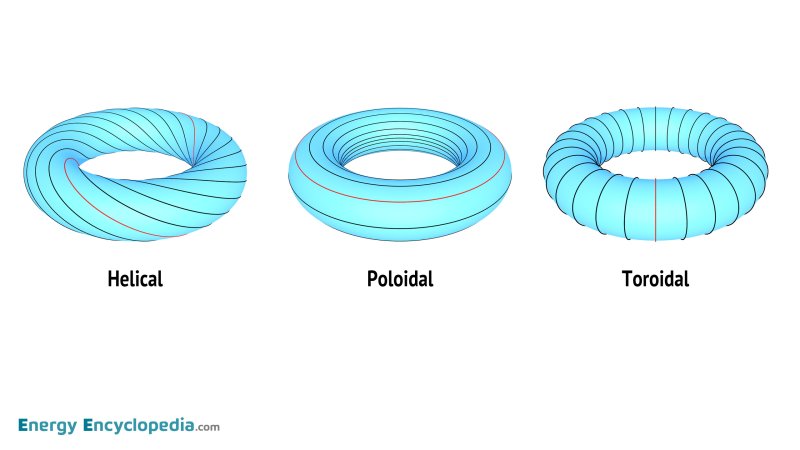
The challenge is to close these field lines without creating "ends" through which particles can escape. The solution is to bend the field into a toroidal shape: a closed ring, donut-shaped. But a simple torus is not enough. On the inner side of the ring, the coils are closer together and the magnetic field is stronger than on the outer side — and particles in a non-uniform field drift. Electrons and ions drift in opposite directions, separating the charges and creating an electric field that pushes the plasma out of the ring.
The solution is to twist the field lines helically, so that each particle alternates between the inner and outer sides of the torus. This way, the drifts cancel out and the plasma remains confined. The Tokamak was designed precisely to generate this helical field.
What is a Tokamak and How Does it Work
The word "tokamak" comes from the Russian acronym "toroidalnaya kamera s magnitnymi katushkami" — toroidal chamber with magnetic coils. The name itself already captures the mechanism.
A tokamak is an experimental magnetic confinement reactor: a torus-shaped chamber where magnetic fields keep the plasma stable, hot, and isolated from the walls. This is made possible by its helical magnetic field, generated by the combination of two fields: the toroidal field, produced by external coils surrounding the chamber, and the poloidal field, generated by an electric current induced directly in the plasma by a central solenoid.
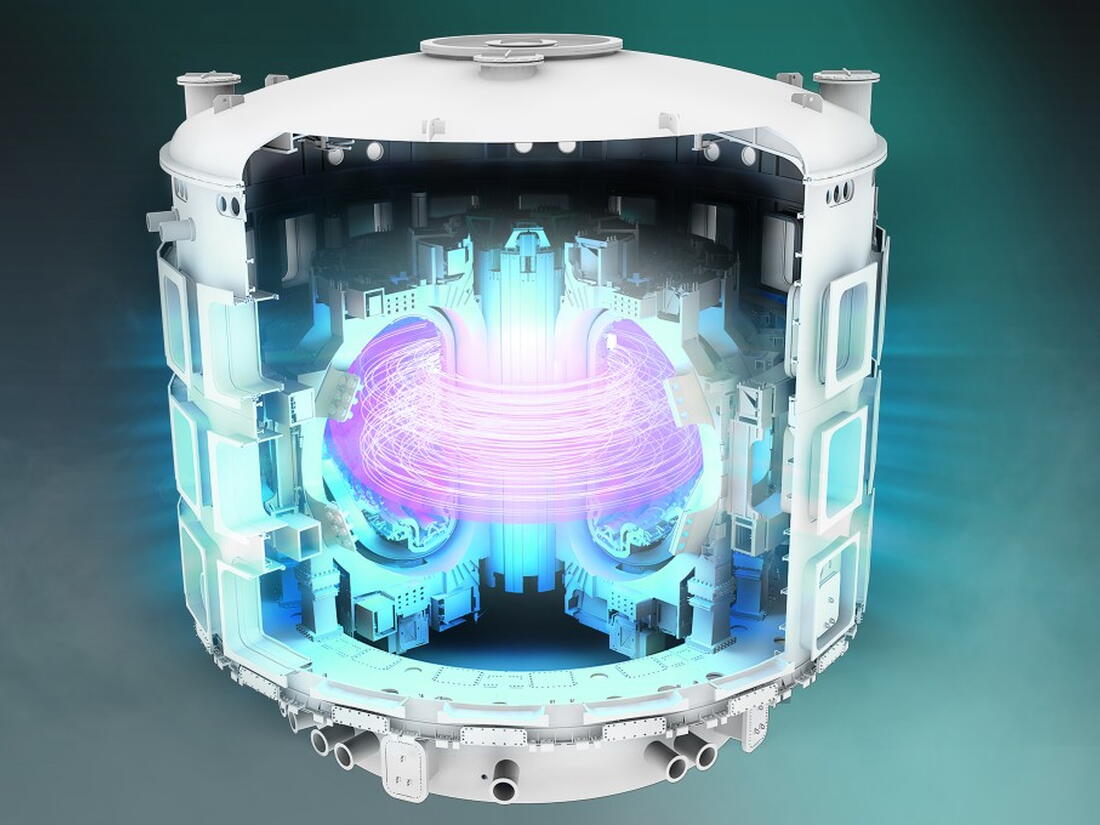
The toroidal field coils are "D"-shaped, not circular. In a circular configuration, the magnetic field would be more intense on the inner side of the ring — where the coils are closer together — and would decrease with distance, generating unequal forces. The "D" shape distributes these forces uniformly, keeping the coil under pure tension.
The combination of both fields twists the magnetic field lines into a helix. Each particle alternates between the inner and outer sides of the torus, the drifts cancel out, and the plasma remains confined. But confining the plasma is only half the problem; the other half is extracting the energy it produces.
How the Tokamak Generates Energy
Inside the confined plasma, deuterium and tritium nuclei collide and fuse. Each D-T reaction produces two byproducts: an alpha particle (a helium-4 nucleus, electrically charged) and a free neutron (uncharged). The total energy released is 17.6 MeV. As seen previously, this energy manifests as kinetic energy, distributed asymmetrically: 80% goes to the neutron and 20% goes to the alpha particle.
This division defines the entire architecture of the tokamak. The alpha particle, being charged, is retained by the magnetic field and remains inside the plasma, transferring its 3.5 MeV directly to the plasma as heat. This internal heating by alpha particles is what enables the creation of a Burning Plasma — a regime in which the reaction becomes self-sustaining, with the plasma itself providing most of the heat needed to maintain fusion, reducing dependence on external heating. Reaching this regime is what would make a tokamak a functional power plant: without self-sustaining, the machine would consume more energy to keep the plasma hot than it could extract from fusion, and the energy equation would never close.
The released neutron, uncharged, passes through the magnetic field without interacting with it and is absorbed by the chamber walls, where its kinetic energy is converted into heat. In a future fusion power plant, this heat would warm water, generate steam, drive turbines, and ultimately produce electricity — operating exactly like a conventional power plant, with the difference that the fuel is deuterium and tritium and the byproduct is helium.
Sources: ITER Organization — What is a Tokamak? · What is Burning Plasma? · FAQs · IAEA — Burning Plasma · DOE — DOE Explains...Burning Plasma · IAEA — Magnetic Fusion Confinement with Tokamaks and Stellarators · EnergyEncyclopedia.com — Tokamak: Main Principles
The Components of a Tokamak
Confining a plasma at 150 million °C and extracting useful energy from it demands engineering of extreme precision. ITER, under construction in Cadarache (France), is the largest tokamak ever designed and brings together seven main systems — each responsible for a specific part of creating, sustaining and protecting the fusion plasma.
Toroidal Field Coils
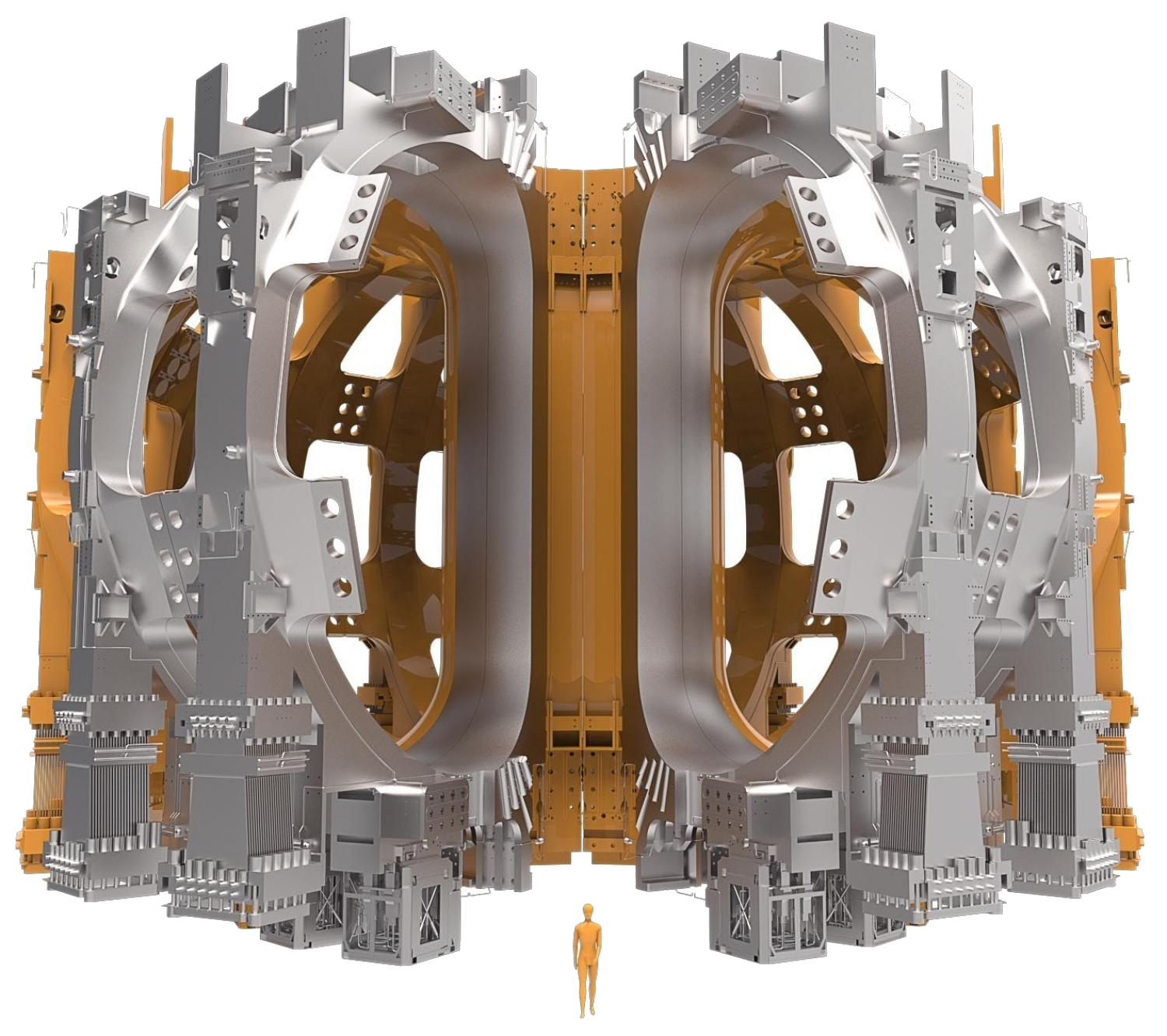
The toroidal field coils generate the tokamak's main magnetic field — the one that gives the plasma its ring shape. There are 18 D-shaped coils arranged around the vacuum vessel, forming a continuous magnetic cage.
Each coil is 17 m tall, 9 m wide and weighs roughly 360 tons, and produces a field of about 11.8 tesla — around 250,000 times Earth's magnetic field. To sustain that intensity without losses the coils are wound with niobium-tin (Nb₃Sn), a superconductor that operates at –269 °C, cooled by liquid helium.
The "D" shape — not a circle — is not aesthetic: it distributes the magnetic forces uniformly, keeping each coil under pure tension and preventing deformation under the stress of hundreds of millions of newtons.
Poloidal Field Coils
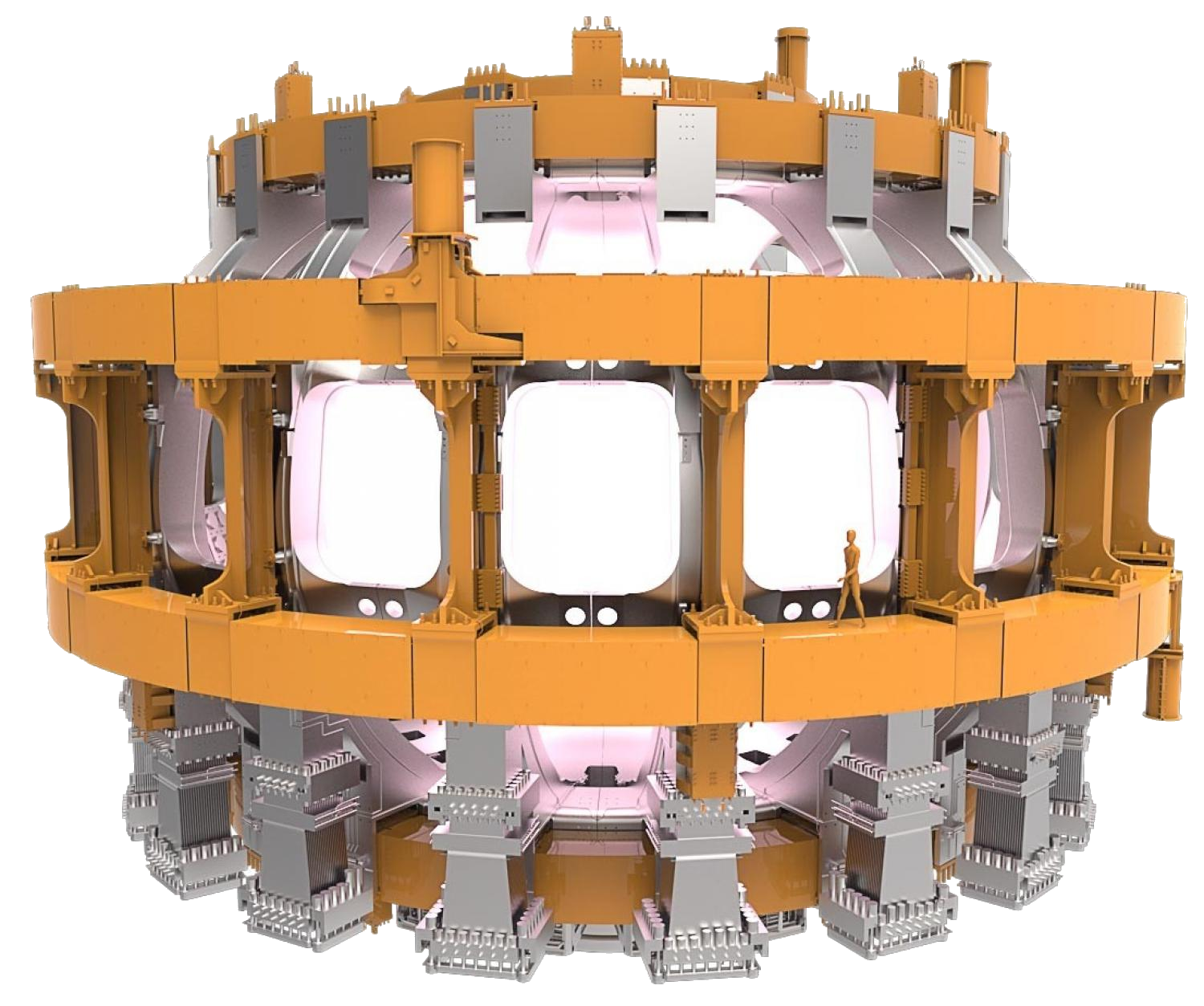
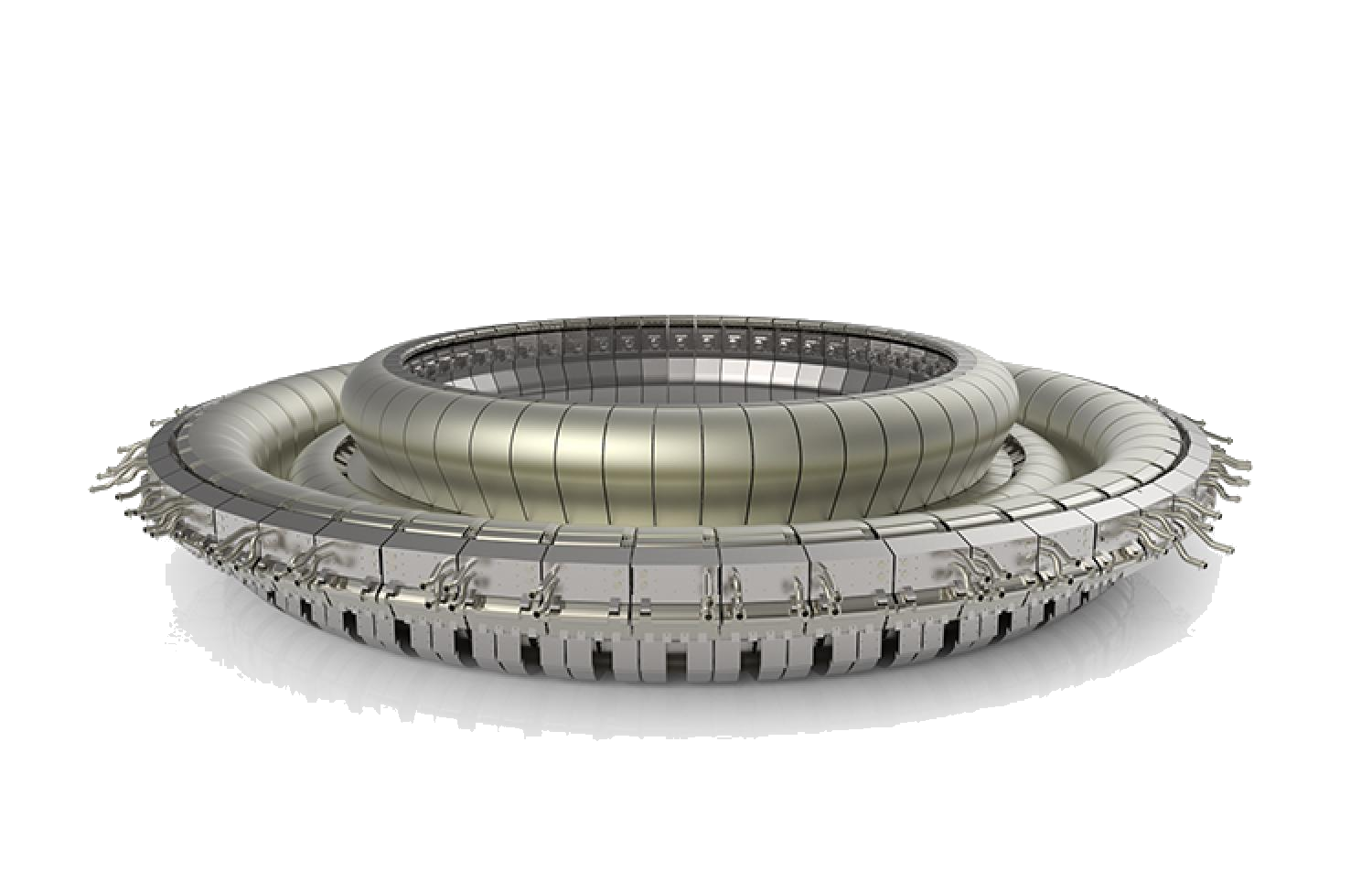
While the toroidal coils give the plasma its ring shape, the poloidal field coils control its position and geometry. There are 6 horizontal rings of different diameters, mounted above and below the toroidal coils and circling the whole assembly.
They shape the plasma — pushing it up, down, compressing or elongating its cross-section — and keep it away from the chamber walls, avoiding direct contact and heat losses. Without them the plasma would be unstable and would strike the surfaces within milliseconds.
ITER's PF coils use niobium-titanium (Nb-Ti) superconductor, simpler than the Nb₃Sn used in the TF coils, sufficient for the lower field they have to generate. The largest is 24 m in diameter.
Central Solenoid
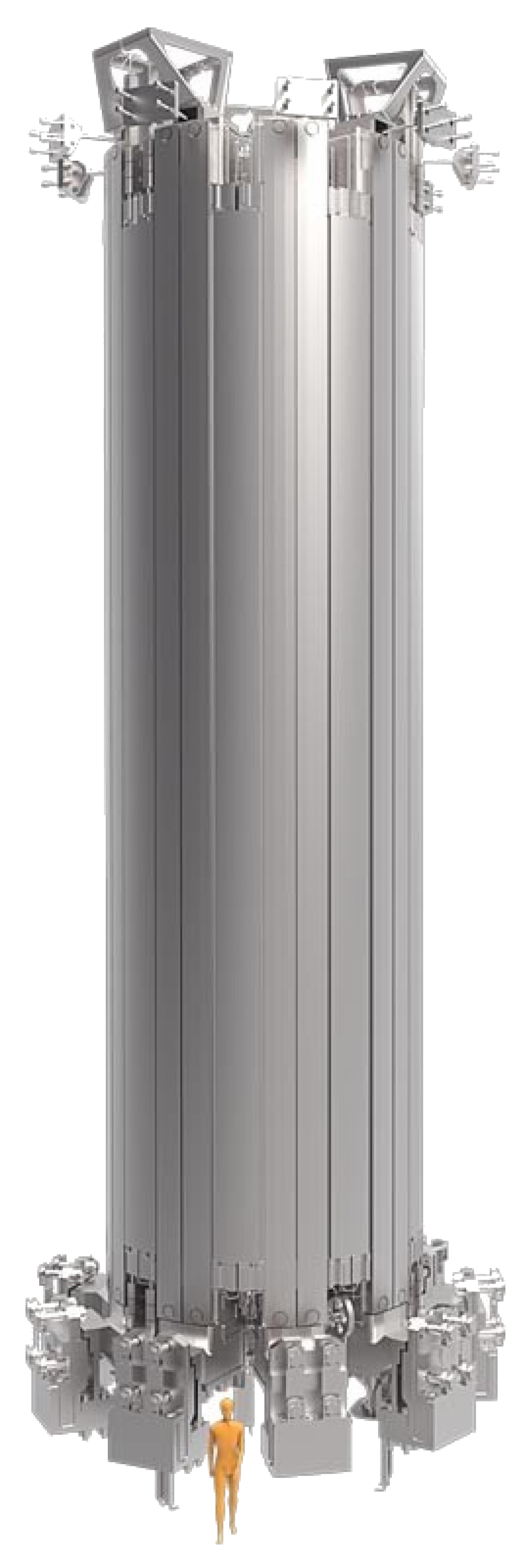
The central solenoid is the magnetic backbone of the tokamak — a vertical column of coils on the machine's axis. Its job is to induce electric current directly in the plasma, acting as the primary of a giant transformer in which the plasma itself is the secondary.
That induced current generates the plasma's own poloidal field, which combines with the toroidal field from the external coils to produce the helical field that actually confines the particles.
ITER's CS is 18 m tall, 4.3 m in diameter and weighs around 1,000 tons. It is built from 6 stacked modules, each using Nb₃Sn superconductor, producing a field of 13 tesla — one of the most powerful magnetic structures ever built.
Vacuum Vessel
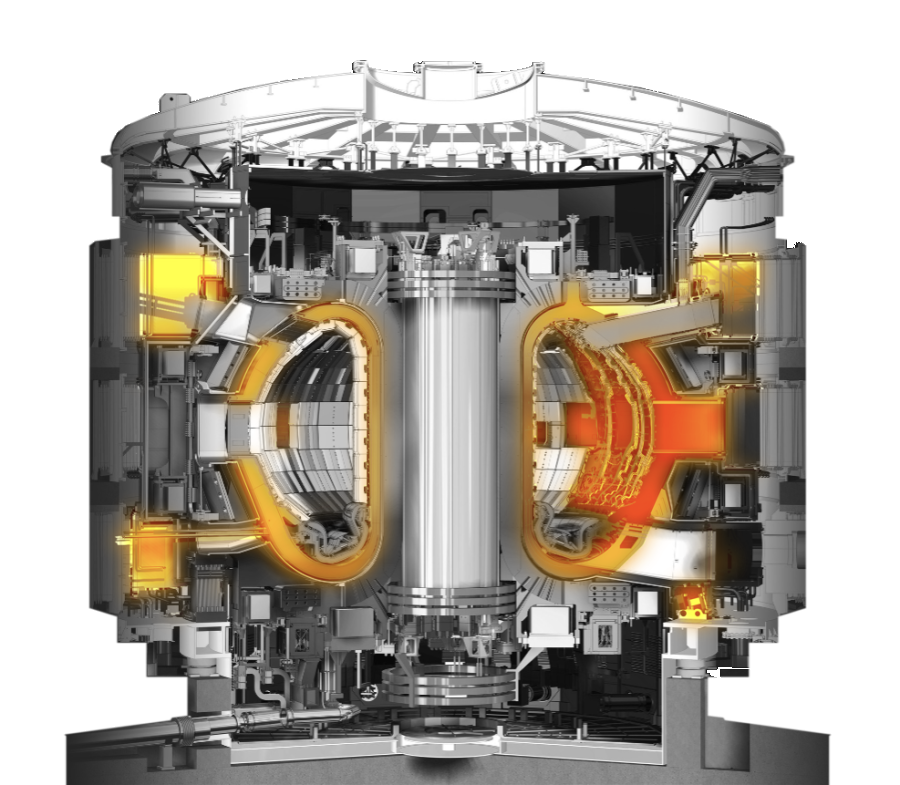
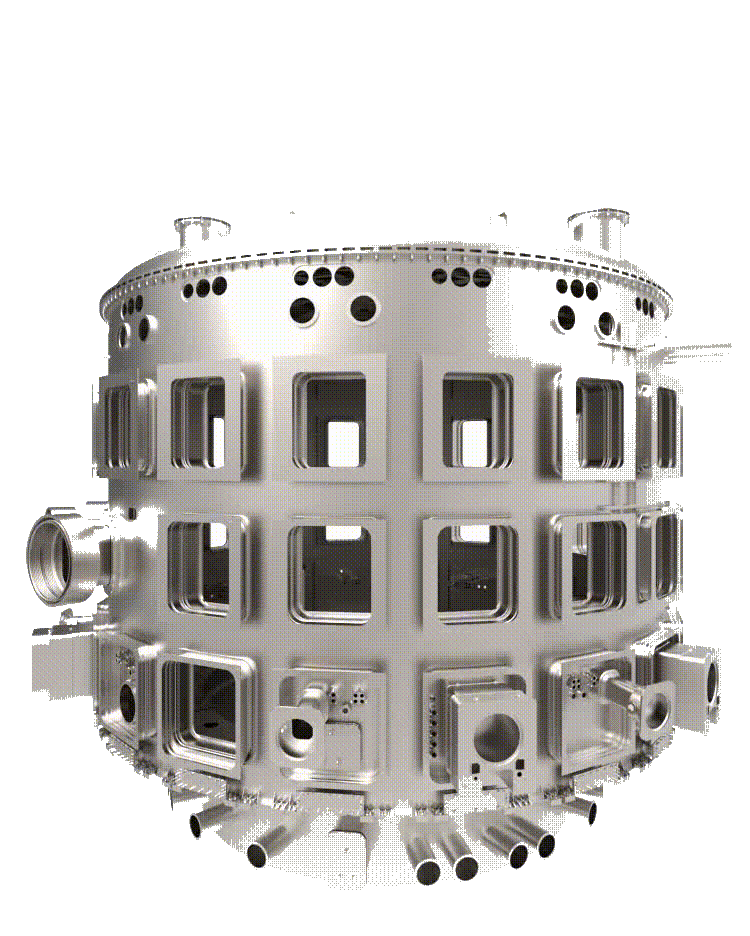
The vacuum vessel is the torus-shaped chamber where the plasma actually lives. It is hermetically sealed and held at ultra-high vacuum (10⁻⁷ Pa): any impurity, even a single air molecule, would contaminate and cool the plasma instantly.
It is also the machine's first safety barrier, containing the nuclear reactions and protecting the outside environment from radiation and tritium. Its double stainless-steel walls are filled with water for cooling and neutron shielding.
ITER's vessel weighs about 5,200 tons, measures 19.4 m across and 11.4 m tall, and provides 44 ports for diagnostics, heating systems and remote maintenance.
Blanket
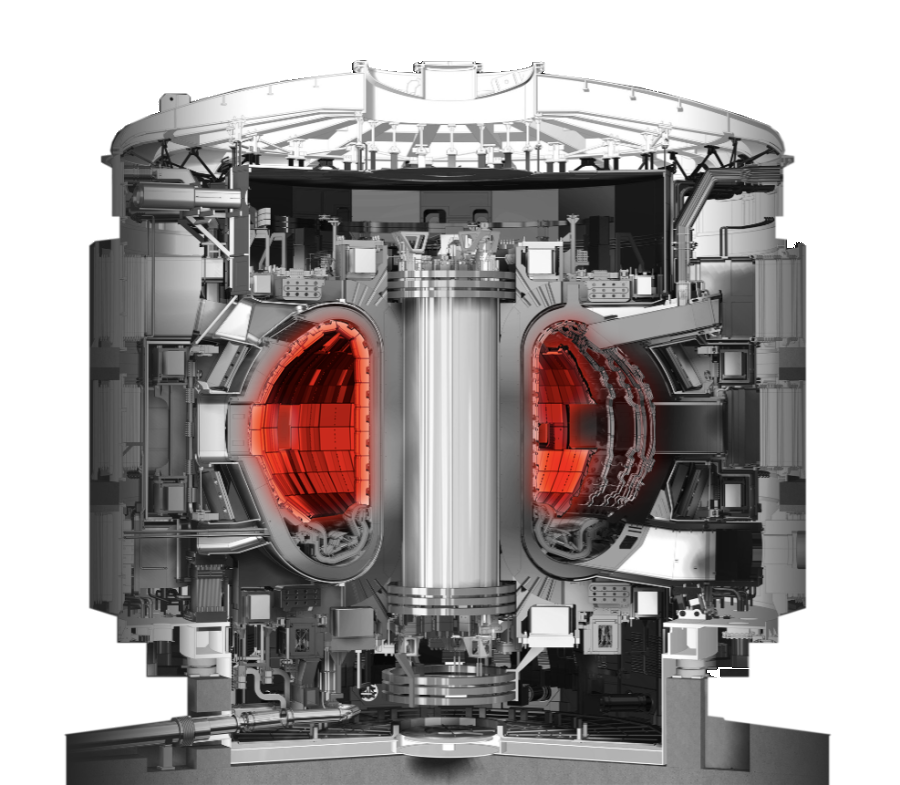
The blanket lines the entire inner wall of the vacuum vessel. It is the first solid surface facing the plasma and has two critical jobs: absorbing the heat and fast neutrons released by fusion reactions and shielding the vessel, the magnets and the rest of the machine.
Recalling that 80% of the energy released by D-T fusion goes to the neutrons, it is in the blanket that this energy is converted into heat — heat which, in a future power plant, will generate steam and electricity. In commercial reactors, the blanket will also contain lithium to breed the tritium consumed by fusion, closing the fuel cycle.
In ITER, the blanket is made of 440 modules of roughly 4.6 tons each, with a first wall in beryllium (and tungsten in the updated baseline), capable of withstanding extreme heat fluxes without degrading.
Divertor
The divertor sits at the bottom of the chamber and is the most thermally stressed component in the whole tokamak. Its role is to extract the ash from the reaction — the helium produced by D-T fusion — before it accumulates in the plasma, dilutes the fuel and chokes the reaction.
It channels the particles leaking from the plasma edge onto special plates, where they are neutralised and pumped out. Those plates withstand 10 MW/m² in steady state and up to 20 MW/m² in transients — ten times the heat flux on a spacecraft re-entering the atmosphere.
In ITER, the divertor is made of 54 stainless-steel cassettes of 10 tons each, removable by remote control. The armour is tungsten, chosen for having the highest melting point of any metal (3,422 °C).
Cryostat
The cryostat encloses the entire vacuum vessel and all the superconducting magnets. It is the largest stainless-steel vacuum chamber ever built: 16,000 m³, 28 m in diameter and nearly 30 m tall, weighing 3,850 tons.
Its role is to maintain the ultra-cold, vacuum environment the superconductors need to operate. In less than 15 m it isolates the interior at –269 °C from the plasma at +150 million °C — one of the most extreme thermal gradients humanity has ever produced.
Sources: ITER Organization — Magnets · Vacuum Vessel · Blanket · Divertor · Cryostat.
Want to see real tokamaks in operation, here in Brazil? See Brazil's tokamaks →
- Wurzel, S. E. & Hsu, S. C. — Progress toward fusion energy breakeven and gain as measured against the Lawson criterion. Physics of Plasmas, AIP, 2022. DOI: 10.1063/5.0083598